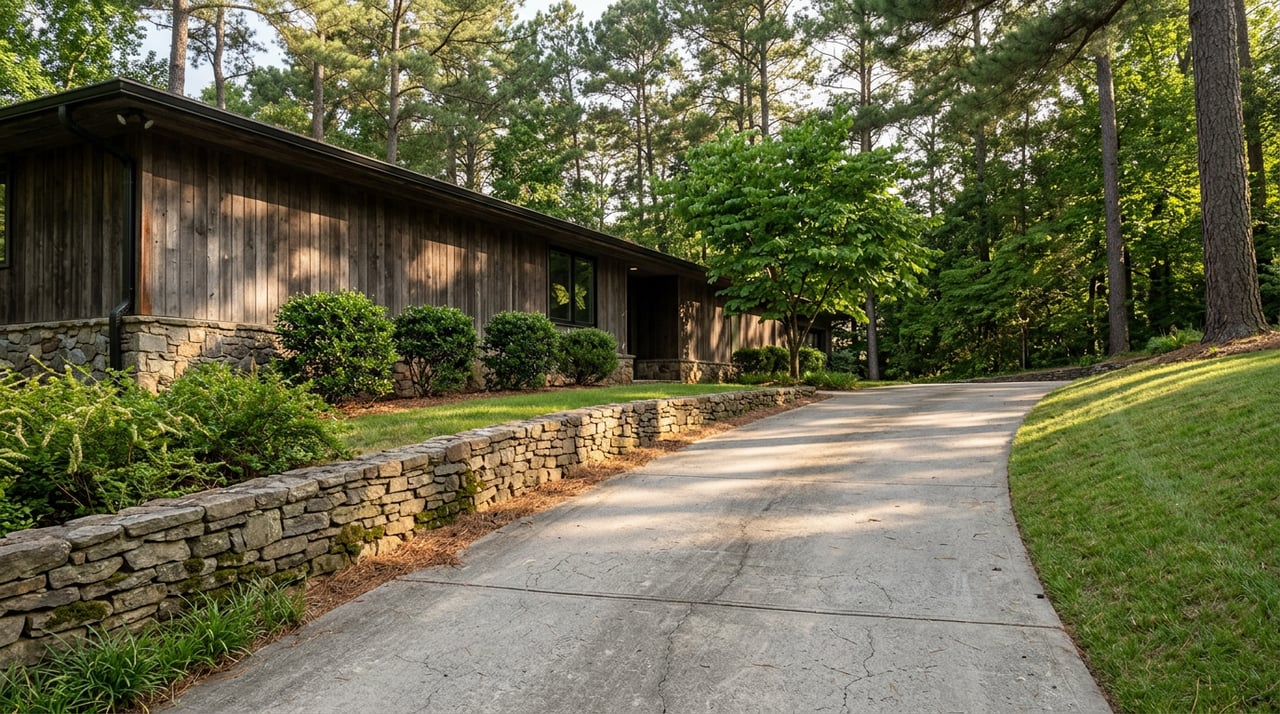
Drive through Robinwood on a Saturday morning and you'll notice what's missing. No sidewalks. No corner store. No cluster of porches where neighbors trade small talk. The streets curve up and down the riverside cliffs the way they have since the 1960s, wide enough for two cars and quiet enough that the loudest thing most mornings is a lawn crew two lots over. That absence of a gathering place isn't an oversight. It's the design. The privacy that drew people here in the first place comes precisely from not having a communal hub inside the subdivision's own lines.
Which raises a real question for anyone who actually lives here: where does the neighborhood's social life happen, if not on Robinwood's own streets? The answer is that it happens a few minutes away, on infrastructure and in businesses that Robinwood residents don't own, don't vote on, and don't control. A federal bridge inspection schedule. A commercial leasing decision made downtown. A church parking lot that turns into a market every Saturday. Understanding Robinwood in 2026 means understanding those outside systems, because they're doing the work the neighborhood was never built to do for itself.
The trail system runs on someone else's maintenance calendar
Three miles north of Robinwood sits the bridge into Two Rivers Park, and a few miles beyond that is the bridge that actually defines the region's outdoor life. The Big Dam Bridge, which opened in 2006 as the longest pedestrian bridge in North America not previously used by trains or motor vehicles, anchors the 15.6-mile core loop of the Arkansas River Trail. Together with the original build's 25 miles of connected exercise paths and the adjacent Two Rivers Park, it's the reason biking and running are treated as a given here rather than a hobby you drive across town for.
That system had a reminder of its own fragility this year. The U.S. Army Corps of Engineers closed the Big Dam Bridge to all pedestrian and bicycle traffic from 8 a.m. to 5 p.m., March 9 through March 13, 2026, for its routine annual inspection, with security gates locked at both approaches. Pulaski County's own notice framed it as routine maintenance to keep the bridge safe for the thousands who cross it every year, which is true, but it also meant five weekdays where the only non-motorized route between the Little Rock and North Little Rock sides of the river simply wasn't there. For a neighborhood whose outdoor recreation depends on a single bridge, that's not a footnote. It's a preview of how much weight one piece of federal infrastructure carries for a private residential street with no trail of its own.
The retail side of that trail dependency lives at Pleasant Ridge Town Center, where Spokes' Giant Little Rock location bills itself as the closest bike shop to the River Trail system, a claim that holds up given its position right off Cantrell Road. The shop, an offshoot of the original Spokes location that opened in Hillcrest in 2010, carries Giant, Cervelo, and Santa Cruz among other brands and runs a full-service repair shop, which matters more here than in most parts of the city because the trail isn't optional scenery. It's the actual commute for a meaningful share of the people who ride it.
Cantrell Road has been doing the work of a town center since 1986
If Robinwood has a front porch, it's a strip of Cantrell Road it doesn't technically belong to. Trio's Restaurant has served New American fare there since 1986, long enough to outlast most of the retail turnover around it, and still runs monthly jazz nights that give the corridor something closer to a cultural calendar than a strip mall usually has. A short distance down the same stretch, the long-running Crazee's Cafe and Count Porkula keep the corridor's other lane covered, with Count Porkula's barbecue built enough of a local reputation that people describe it in the kind of specific, sensory terms usually reserved for restaurants that have been getting it right for decades.
None of these businesses are inside Robinwood. All of them function as if they were. That's the pattern worth naming: the neighborhood's actual social infrastructure, from where people eat to where they exercise, sits just outside its borders, on land and under ownership the subdivision has no say over.
Saturday mornings still belong to a church parking lot
The Hillcrest Farmers Market, a service of Pulaski Heights Baptist Church at 2200 Kavanaugh Blvd, runs Saturday mornings year-round and has grown from nine vendors at its start in 2010 to more than 28 on a typical summer Saturday. Through the current May-to-September stretch it runs 8 a.m. to noon, shifting to shorter fall and winter hours once the season turns. It's the kind of institution that has nothing to do with any single subdivision and everything to do with how a whole cluster of Little Rock neighborhoods, Robinwood included, actually spends a Saturday morning: produce, eggs, honey, and a stroll down Kavanaugh that has more foot traffic than anything on Robinwood's own streets.
The mall three miles west got a new landlord this year
Pleasant Ridge Town Center, anchored by Belk and The Fresh Market on Cantrell Road, is the closest thing Robinwood has to a shopping district, and its leasing changed hands in the past year. Moses Tucker Partners was named the center's exclusive leasing agent, with firm principal Chris Moses framing the move as stewardship of what he called a "legacy property" and a push to build out the tenant mix. The current roster already includes Chick-fil-A, Chipotle, Crumbl, Sephora, Pure Barre, Sissy's Log Cabin, The Buttered Biscuit, Urban Outfitters, and Bar Louie alongside the anchor stores, which is a wider spread of daily-errand and occasional-treat businesses than the center has typically carried.
The smaller stores tell a more interesting story than the national names. Olive Oil & Vinegar, tucked into Pleasant Ridge II near the UPS Store and Santa Coyote, has built a following on Nextdoor for letting shoppers sample flavored oils and vinegars before they buy, the kind of specialty retail that survives on repeat local customers rather than foot traffic from a highway exit. It's a small business decision, made by people who don't live in Robinwood and answer to no one in the neighborhood, that shapes what a Robinwood resident can pick up on the way home from work.
What this actually means if you live here
There's a version of this neighborhood's history that residents already know without needing it explained: the wooded lots, the lack of through traffic, the sense of being tucked away from the rest of the city even though downtown is eight miles down the road. One home in Robinwood itself, once belonging to businessman and philanthropist Jennings Osborne, drew enough drive-by holiday visitors each December that it reportedly backed up traffic on Cantrell Road and the nearby interstate, a strange bit of local trivia that captures how a single private property here could once ripple out to affect an entire corridor.
That's really the throughline. Robinwood was built to be self-contained in the sense of privacy and quiet, but it was never built to be self-sufficient in the sense of having its own commercial or recreational core. Every part of daily life that makes the neighborhood feel connected to something bigger, the trail rides, the Saturday market run, the Friday dinner at Trio's, the weekend stop at Pleasant Ridge, depends on decisions made by the Army Corps of Engineers, a leasing firm downtown, a church congregation, and a handful of family-run restaurants that have simply stuck around. None of it shows up on a map of Robinwood's own boundaries. All of it is what actually fills the gap where a town square would normally be.
If you're weighing what a specific stretch of the Robinwood or River Ridge area is really like day to day, that's the kind of on-the-ground context worth having before you look at a single listing. Will Smith Realty works these Little Rock submarkets closely enough to walk you through them street by street. Let's find your next home, or talk through what your property is worth in this market.